
Hale End reset: Arsenal’s academy enters a new era
Arsenal’s academy is entering its biggest structural shift in years, with leadership changes, recruitment expansion and a stronger focus on monetising talent.
YOUTH& DEVELOPMENT
Arsenal Footy Hub
3/3/20262 min read
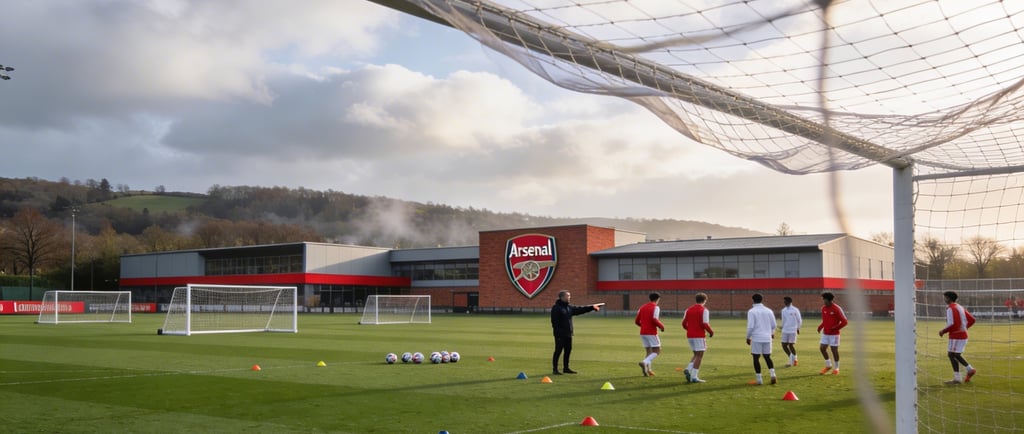
Leadership is shifting. Recruitment is widening. And Hale End is being asked to generate value as well as first-team players.
This isn’t a cosmetic change. It’s structural — and it could redefine what Arsenal’s academy is for over the next five years.
Leadership reset
Per Mertesacker will step down as academy manager at the end of the 2025–26 season, closing an eight-year period that helped produce Bukayo Saka, Myles Lewis-Skelly, Ethan Nwaneri and others who now form part of the club’s core.
James Ellis, promoted to technical director last summer, is also leaving after only seven months. His role was to tighten the link between the academy, recruitment and first-team planning — including involvement in moves like the Quintero twins and securing Max Dowman’s long-term future.
Those two exits remove both the architect of the Hale End era and the bridge figure meant to align youth strategy with the senior project.
Under sporting director Andrea Berta, the academy is expected to report more directly into the central sporting structure. That suggests tighter control — and clearer accountability.
From pathway to profit engine
Arsenal have accepted that, compared to clubs like Chelsea and Manchester City, they haven’t maximised academy sales and sell-on value.
They’ve produced first-team players.
They haven’t consistently monetised the rest.
The new philosophy appears simple:
If you’re good enough, you stay.
If not, you generate meaningful transfer value.
That doesn’t mean abandoning development. But it does suggest earlier decisions, firmer contract strategy, and more structured loan pathways designed either for Arteta or for the market.
A broader recruitment map
Publicly, Arsenal remain London-first. That won’t change.
But two clear recruitment lanes have emerged beyond the capital: Scotland and South America.
In Scotland, moves for players like Callan Hamill and Evan Mooney reflect a low-cost, high-upside strategy. Teenagers with senior minutes. Domestic experience. Potential homegrown classification within three seasons.
In South America, the agreement for Ecuadorian twins Edwin and Hólger Quintero from Independiente del Valle signals a longer-term play: build relationships with elite academies, secure high-ceiling prospects early, and accept delayed return in exchange for upside.
It’s more strategic. Less reactive.
What this means on the pitch
Short term, academy squads may become:
Smaller
More selective
More performance-focused
There could be a slightly older profile in some age groups — teenagers with senior exposure mixing with long-term Hale End prospects.
For Arteta, tighter alignment with the sporting director likely means recruitment profiles that fit the system first: press-resistant, technically clean, positionally flexible.
The question is whether the balance holds.
Mertesacker’s “Strong Young Gunners” philosophy placed heavy emphasis on personal development alongside footballing growth. If the new leadership leans too hard into commercial outcomes, that culture could thin out.
The upside and the risk
The upside is clear.
If prospects either break through or generate strong fees, Arsenal strengthen both squad depth and financial flexibility. It becomes a self-sustaining model — competitive without matching state-backed spending.
The risk is subtler.
An academy built too heavily around resale can drift into churn. Players move through the system without ever feeling fully integrated. The emotional connection between Hale End and the first team weakens.
Get it right, and Arsenal could blend identity with efficiency — first-team pillars alongside a steady revenue stream.
Get it wrong, and Hale End becomes transactional.
This reset isn’t minor. It’s structural.
And over the next five years, it will quietly shape what Arsenal look like — both on the pitch and on the balance sheet.
Arsenal Footy Hub
Long-form writing on Arsenal, youth development, and the structures behind modern football.