
Arsenal vs Manchester United: when a title race shows its weight
Arsenal’s 3–2 defeat to Manchester United exposed how pressure, decision-making, and late-game errors reflected the psychological weight of a title race.
ANALYSIS
Arsenal Footy Hub
1/27/20263 min read
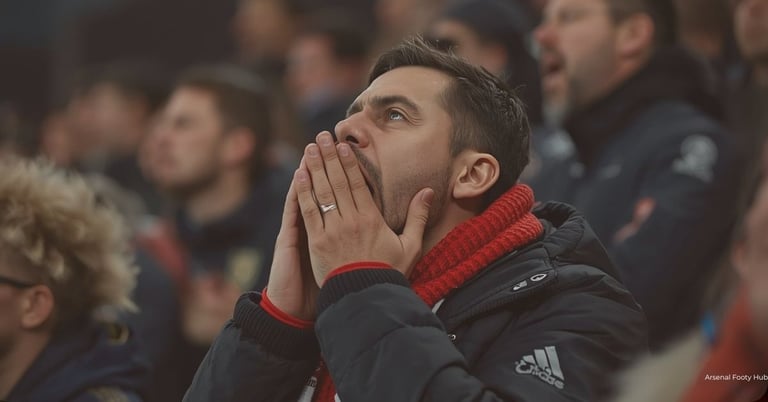
Arsenal’s home defeat to Manchester United wasn’t really about being tactically outplayed. It felt more like a team buckling under the emotional weight of a title race — losing composure at exactly the wrong moments.
On paper, this was supposed to be routine. Arsenal came in as league leaders, with a chance to stretch their cushion after rivals had already won. The start reflected that. High press, territorial dominance, and a deserved opener when Lisandro Martínez turned Bukayo Saka’s cross into his own net.
At 1–0, it looked familiar. Score first. Suffocate the opponent. Control the tempo. See it out.
Instead, that goal became the moment everything tilted.
From control to chaos
After going ahead, Arsenal’s calm with the ball disappeared. The circulation became rushed. Decisions felt anxious. United didn’t suddenly impose themselves — Arsenal invited them back in.
The equaliser summed up the shift. Building from the back, Martin Zubimendi played a needless pass in a dangerous area. Bryan Mbeumo read it, rounded David Raya, and finished. It was the kind of mistake Arsenal have largely cut out this season — not a systemic flaw, but a lapse in concentration at exactly the wrong moment.
More importantly, it cracked something mentally. From that point, Arsenal stopped looking like a side in command. Passes under no pressure went astray. Distances between the lines stretched. Even usually reliable figures like William Saliba and Gabriel were dragged into awkward duels and loose second balls. This wasn’t tactical collapse. It was a collective drop in clarity, the sort that often shows up when pressure rises.
United’s second goal followed the same theme. Arsenal failed to reset properly after losing possession, space opened up between the lines, and Patrick Dorgu smashed in a stunning strike off the bar. Spectacular finish — but born from passive defending and a moment where Arsenal reacted instead of dictated.
The system held. The nerve didn’t.
Tactically, Arteta didn’t abandon what’s worked all season. The press was there. The right-side overloads through Bukayo Saka and Martin Ødegaard were still a feature. The midfield rotations were designed to control second balls and territory.
United’s plan was simple and effective: stay compact, stay alive, and attack quickly through Bryan Mbeumo and Matheus Cunha when Arsenal lost control.
The telling detail isn’t the shape — it’s the context. Before this match, Arsenal had conceded very few league goals at the Emirates all season. United alone scored three. That doesn’t point to structural failure. It points to concentration and emotional management.
The most revealing moment came after Mikel Merino’s late equaliser.
At 2–2, with momentum back and the league lead still intact, the sensible play was to slow everything down. Reset. Take the sting out of it. A point wouldn’t have been a disaster.
Instead, Arsenal chased the winner.
Within seconds, Cunha and Kobbie Mainoo combined, space opened up, and Cunha curled in from distance. A brilliant strike — but made possible by Arsenal over-committing and leaving themselves exposed in rest-defence.
It was ambition meeting poor risk control.
A title race showing its weight
Some of this is “one of those games.” United needed two outstanding long-range finishes and a rare individual error to win at a ground where almost nobody has managed to do damage this season. On another day, this is a messy 2–2 and we’re talking about Arsenal’s recovery.
But timing matters.
Arsenal came in off consecutive draws. City and Villa had both won earlier in the weekend. The stadium knew what was at stake. Add that to a squad with fresh memories of previous title races, and you get what felt visible: tension in the stands, rushed decisions on the pitch, and a feedback loop where one mistake makes the next more likely.
This was also the first time in a long run that Arsenal conceded three goals in a competitive match. They’re still top. They still have 50 points from 23 games. But the margin feels thinner now — and that psychological pressure is starting to show in clusters of errors rather than isolated moments.
One bad day — but not just that
The truth sits in the uncomfortable middle.
Yes, United needed freakish finishes. Yes, Arsenal are still one of the best defensive sides in the league. Yes, this could be written off as an outlier.
But the recent pattern — shakier control after scoring, build-up decisions made under stress, and late-game risk-taking — suggests this isn’t completely random either.
This looks like a team good enough to lead a title race, now learning what it actually feels like to carry one.
So the question isn’t whether Arsenal can avoid another bad afternoon altogether. That’s unrealistic.
The real question is whether they can absorb this without letting it turn into a habit — because the margins at the top aren’t just tactical anymore.
They’re emotional.
Arsenal Footy Hub
Long-form writing on Arsenal, youth development, and the structures behind modern football.