
Arsenal 3–2 Bournemouth: imperfect, volatile, and title-level valuable
Arsenal’s 3–2 win at Bournemouth was messy but decisive, driven by set-pieces, Declan Rice’s late runs, and calm late-game management.
ANALYSIS
1/5/20262 min read
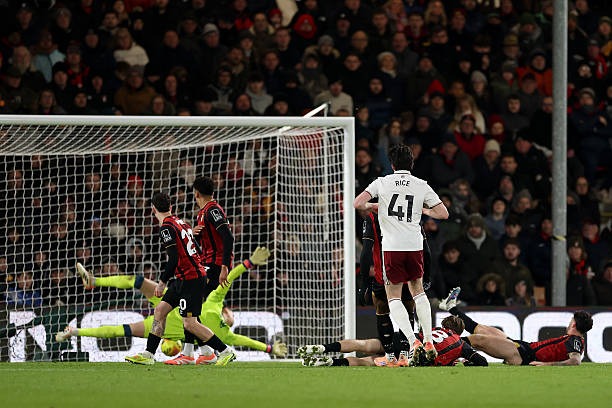
Arsenal’s 3–2 win at Bournemouth was a high-variance away performance where set-pieces, Declan Rice’s box threat and late-game control outweighed a shaky first half and rare defensive looseness. It wasn’t polished, but it was the kind of win title challengers collect.
Match context and game state
Bournemouth arrived on an 11-game winless league run but pressed with real aggression. Arsenal, meanwhile, were trying to turn autumn dominance into separation at the top.
The result pushed Arsenal six points clear, with Manchester City holding a game in hand. This was a pressure fixture, not a free swing.
Bournemouth edged the first half in chance quality, front-loading most of their xG (1.34 vs Arsenal’s 1.17 overall). Arsenal’s edge came later — from efficiency, set-pieces, and better game management once they settled.
Bournemouth’s press vs Arsenal’s build-up
Bournemouth pressed high and directly targeted Arsenal’s first phase. The opener summed it up: Gabriel’s loose pass into traffic, punished by Evanilson finishing into an empty net.
That moment reflected a wider issue early on. Arsenal were uncharacteristically ragged, rushed under pressure, and prone to miscommunication. Bournemouth fed off that and built early momentum.
Arsenal’s adjustment was pragmatic rather than pretty:
Safer progression through full-backs and Rice
Fewer forced central passes
Greater reliance on set-pieces, where Bournemouth are statistically vulnerable
That shift stabilised the game without fully killing Bournemouth’s threat.
Set-pieces, Rice, and right-side influence
The equaliser came from controlled chaos. A worked free-kick, a driving action from Noni Madueke, and Gabriel staying alive to finish — a sharp response after his earlier error.
Across the match, Arsenal generated threat beyond their raw xG:
Set-pieces: 0.40 xG from dead balls vs Bournemouth’s 0.12
Rice: high-quality shooting locations and late arrivals rather than volume touches
Bukayo Saka’s second-half influence was decisive. His 1v1 threat and inside carries directly precede the third goal, where his line-breaking run opens space for Rice to finish.
Individual focus: Gabriel and Rice
Gabriel’s performance was about recovery. After the opening mistake, he simplified his game, defended the box aggressively, and delivered the equaliser. From error to momentum shift.
Rice’s brace went beyond goals:
First: arrives at the edge after Bournemouth’s line is occupied and shifted, curling into the corner
Second: classic late box arrival after Saka breaks the line
With Rice carrying a knee concern pre-match, Arsenal clearly managed his workload early, then leaned on him as a tempo-setter and finisher after the break.
Control, variance, and late-game management
On paper, Bournemouth shaded open-play chance quality. On the pitch, the difference came in game state.
Before Arsenal led: Bournemouth’s press and direct attacks carried real danger
After 3–1: Junior Kroupi’s spectacular strike made it 3–2, but Arsenal’s block held and Bournemouth’s xG rate slowed
The final phase was about risk control, not dominance. Arsenal slowed restarts, recycled possession, and avoided unnecessary transitions. No chase for a fourth. No chaos invited.
That’s how title-chasing sides close volatile away games.
Bottom line
This wasn’t Arsenal at their cleanest. It was Arsenal at their most resilient.
They absorbed pressure, leaned on structure, maximised set-pieces, and managed the closing stages without losing their heads. Over a season, these are the wins that matter.